La soledad
La piel del tamborLa soledad names a defining tension in the novel: its characters endure loneliness in private, yet sometimes recognize one another through that very isolation. For clergy in particular, shared rituals and an instinctive solidarity offer companionship without dissolving the rules and inward separateness that govern their lives. The concept also reaches beyond the church: unanswered letters, bereavement, and a ruined prospect of family make solitude a material consequence of memory and loss, while the night sky gives it a cosmic scale.
Solitude and clerical recognition
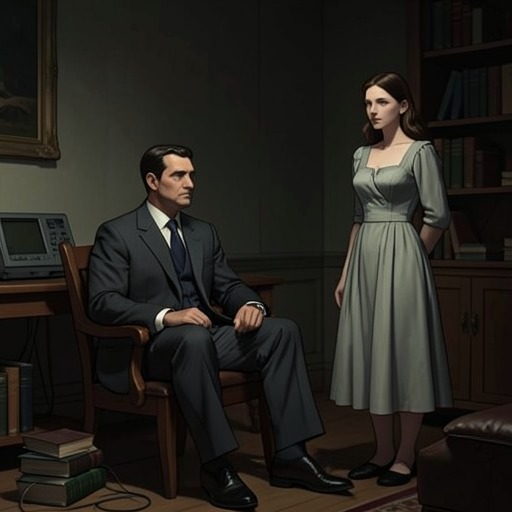
Gris Marsala describes places and people that cannot be passed through without consequence, naming the city, its church, Príamo Ferro, and Macarena Bruner. Her warning makes belonging feel like exposure: entering these lives means entering their accumulated histories and vulnerabilities. She also recognizes in Quart a resemblance to Ferro, a man who, like him, seems to have little left to lose. Solitude is not simply being alone; it is the condition that makes certain encounters feel dangerous and immediately legible.
That recognition becomes a particular kind of fellowship between clergy. When Gris and Quart look at one another without speaking, Quart understands the moment as a painful solidarity between people who perform related offices in a difficult world. Their closeness consists of ritual, intuition, tacit understanding, group instinct, and parallel loneliness. Gris’s question about a life surrendered to her father’s control deepens the bond: she wonders what a woman can do when, at forty, she understands that fear of displeasing him has cost her the chance to live a life of her own. Quart does not claim to know the answer. He offers a tentative image of breaking a mirror and buying another, and says that doing so requires courage. The exchange gives their companionship force precisely because it cannot repair the lost years or supply a simple solution.
Ferro, death, and the limits of belief
Ferro gives solitude a history measured in decades. As a young priest, he read the philosophers from Socrates to Augustine, but says that what remained was a bittersweet taste of melancholy and disillusionment. At sixty-four, he reduces what he knows of human beings to the facts that they remember, fear, and die. He recalls seeking God in the heavens and wanting a direct reckoning, after witnessing people suffer and die. His bishop and the bishop’s circle forgot him; his life became one of terrible solitude, interrupted by Sunday Mass in a small, nearly empty church and journeys through snow, rain, and mud to bring the last rites to the dying.
For a quarter of a century, Ferro sat beside people who clung to his hands because he was their only comfort. He spoke in one direction and received no answer. The account makes pastoral care less a triumph over loneliness than the act of remaining present where no answer comes. His doubt does not cancel the work: the dying still need a hand to hold, and their dependence gives his presence meaning even when his prayers do not return with certainty.
The problem becomes philosophical when Quart raises the possibility that people are born and die either according to a plan or by accident. Ferro does not treat the question as a settled answer. He asks how life’s message can be preserved in a world marked by death, where ordinary people may leave no memory after they are gone. Faith, in this account, becomes hope and consolation against the possibility that the universe is senseless. Ferro even allows that the Pope may no longer believe in God, but insists that those who come to his church do believe, and that their faith is enough to justify its existence.
The church as shelter, and consolation as need
Ferro defends Nuestra Señora de las Lágrimas not by making his own certainty the test of its value, but by pointing to the people who rely on it. Its Baroque character matters to his argument: the sculptures, faded or gilded surfaces, sumptuous altars, and dramatic passions give worshippers something to contemplate and feel. He describes this Counter-Reformation inheritance as a way to set analysis aside and be overwhelmed by divine glory. Quart objects that such a church risks alienating people, reducing it to the television of the seventeenth century. Their disagreement turns on a question the novel does not flatten: whether consolation obtained through spectacle is false comfort, or a necessary refuge for people who cannot bear the full force of analysis and despair.
Ferro’s image of the church as firm ground against a tumultuous torrent makes its pastoral purpose concrete. The church’s value lies not only in doctrine but in the comfort it can provide to those who arrive believing, grieving, or afraid. His defense therefore sits uneasily beside his own unanswered appeals to God. The institution may shelter others even when its priest cannot claim to have found the assurance it promises.
Letters, grief, and the loneliness of the living
The letters connected to Carlota make solitude visible as failed communication. Macarena explains that Manuel Xaloc never read the letter Quart is examining, or any of the others. Carlota retained her sanity for another six months before, as Macarena puts it, darkness came. When Xaloc eventually visited, in his blue uniform with gold buttons, Carlota was already dead in all but bodily presence: the woman before him could not recognize him. The letters had travelled toward someone who never received them, turning private declarations of love and appeals for help into a dialogue without an answer.
Quart folds the letter and returns it to its “cemetery of yellowed paper,” a stack of envelopes like gravestones over messages sent blindly into darkness and emptiness. His discomfort is more than sorrow at the outcome. He feels almost guilty for intruding on the intimacy of a conversation that could not be answered, and the letter leaves him with shame as well as grief. The image binds memory to physical objects: paper preserves words, but cannot guarantee that anyone will hear them in time.
Macarena’s own disclosures reveal another form of isolation: the aftermath of a pregnancy, an abortion, and the loss of the possibility of having children. She recalls the cold, frightening solitude of the procedure and directs her anger at men, including Quart. Later, she describes the moment, three months after returning, when she watched Pencho Gavira shower after they made love for the first time. His smile made him seem like a perfect stranger, unrelated to the man she had loved and for whom she had lost the possibility of children. The recollection connects physical experience to delayed recognition: the rupture in her life becomes newly legible in an ordinary domestic scene, rather than disappearing when the event itself is over.
Companionship beneath an indifferent sky
Macarena tells Quart that his announced departure unsettles her. She proposes several possible reasons for confiding in him: a priest can seem strong and wise, someone to trust or confide in; Quart’s black clothes and collar, his attractiveness, and his arrival from Rome may also draw her to him. She even wonders whether she is trying to make him her Vísperas, win him to her cause, or wound Pencho’s honor. She does not settle on one explanation, allowing several motives to coexist. In her life, she says, Ferro and Quart occupy opposite but complementary ends of a reassuring terrain. Quart sees the connection between her need for the church and her need for these men: she needs the church as much as the others do.
In the observatory, Ferro gives this need its bleakest setting. He asks what human lives and efforts mean beneath the stars, where even the report to Rome, the church, the Pope, and the two priests seem negligible. Stars die and are born, planets perish and arise, and the universe continues apparently unchanged after individual lives have ended. Quart feels the same instinctive clerical solidarity as before, imagining exhausted warriors isolated in their separate squares on a chessboard, each fighting uncertainty by his own means. He wants to put a hand on Ferro’s shoulder but holds back: their rules include each person’s solitude.
Ferro, however, calls astronomy a source of serenity rather than despair. Only what matters can hurt when it is lost; lucidly recognizing human smallness is therefore not the same as declaring human life worthless. Against the image of a person as a tiny drop in the sea at the universe’s red sunset, he sets the possibility of a friendly hand offering resignation and comfort before the stars go out. The scene does not resolve the distance between cosmic indifference and human need. It makes companionship a limited but consequential answer: not rescue from mortality, but company before the cold and the end.
Solitude as both bond and separation
Quart’s relations with Macarena and Ferro show that shared loneliness can draw people close while leaving their boundaries intact. With Ferro, the bond is shaped by clerical recognition and a desire for contact that Quart restrains; with Macarena, intimacy briefly blurs limits, but she repeatedly turns back toward her concern for Ferro and the church. When Macarena fears that Pencho’s apparent alternative will not save Ferro, Quart is left grieving not only her words but the movement by which she comes near and then withdraws. Her gestures revive their recent intimacy, yet she moves away again, leaving him aware of how much Sevilla has taken from him and how little it has given in return beyond a painful consciousness of himself.
That ending returns the concept to its central contradiction. Solitude is parallel, shared, and recognizable, but it is not interchangeable: one person cannot inhabit another’s grief or make the answer arrive. The novel’s consolations—letters kept, rituals repeated, the church defended, a hand offered in the dark—do not erase isolation. They establish why people continue to seek one another within it.